Best Cloud Platform for AI Workloads: AWS vs Azure vs GCP
By Anil Rana
Cloud AI has moved from experimentation to infrastructure planning. Enterprises are no longer asking whether they should use AI. They are asking where it should run, how much it will cost, how secure it will be, and whether the platform they choose today will still make sense two years from now.
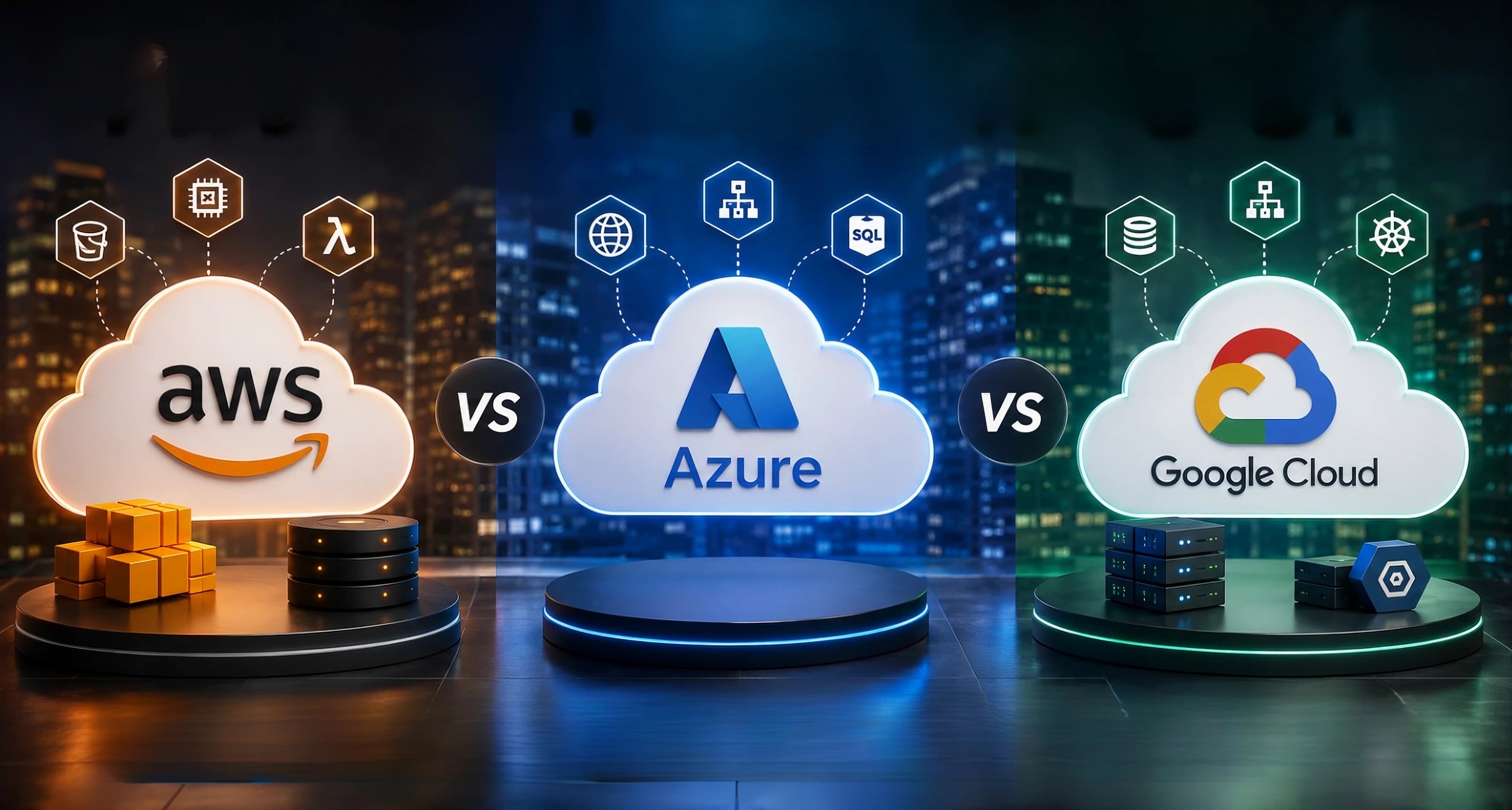
That is why the AWS vs Azure vs GCP for AI debate matters more in 2026 than it did even a year ago. Market estimates still place AWS as the largest cloud provider, Azure as the strongest enterprise challenger, and Google Cloud as the fastest-rising AI and data cloud contender, though exact shares vary by source and quarter. Microsoft reported 39% Azure and other cloud services growth in FY26 Q2, while Alphabet reported 63% Google Cloud revenue growth in Q1 2026, driven strongly by AI products and infrastructure.
Let's find out exactly which cloud fits your AI use case.
What Has Changed in Cloud AI in 2026?
The biggest change is that generative AI is no longer sitting in a proof-of-concept sandbox. Enterprises are now moving GenAI into customer support, contract intelligence, fraud detection, clinical workflows, developer productivity, sales operations, and knowledge management.
A few shifts define the current cloud AI platform enterprise 2026 landscape.
First, model access is becoming more fluid. AWS and OpenAI have expanded their partnership, bringing OpenAI models, Codex, and managed agents to AWS environments through Amazon Bedrock in limited preview. That changes the old assumption that OpenAI workloads automatically meant Azure.
Second, Azure has moved deeper into the enterprise workflow layer. Microsoft 365 Copilot crossed 20 million paid enterprise seats, while Microsoft Foundry is being positioned as a unified platform for enterprise AI operations, model builders, and application development.
Third, Google Cloud has become a serious AI infrastructure and data platform conversation. Alphabet’s Q1 2026 update reported 63% Google Cloud revenue growth, revenue above $20 billion, and strong demand for AI products and infrastructure.
Fourth, multi-cloud is now normal. Flexera’s cloud research continues to show 89% of organizations taking a multi-cloud approach, which means the best answer may not be “choose one cloud forever.” It may be “place the right AI workload on the right cloud, with governance strong enough to control all three.”
AWS for AI Workloads: Services, Strengths and Best Fit
AWS is still the safest default for organizations that already run a large share of their infrastructure on Amazon Web Services. Its AI story is built around breadth, scale, model choice, and strong MLOps depth.
The core services to understand are Amazon Bedrock, Amazon SageMaker AI, Trainium, and Inferentia.
Amazon Bedrock
Amazon Bedrock is AWS’s managed foundation model layer. It gives enterprises access to multiple model providers through a unified environment, and AWS now says OpenAI models on Bedrock expand that choice further. This makes Bedrock useful for multi-model RAG systems, enterprise copilots, agentic workflows, customer service automation, and internal knowledge assistants where teams want flexibility instead of being tied to one model family.
Amazon SageMaker AI
It is stronger when the use case involves custom ML, fine-tuning, model training, feature pipelines, experimentation, and MLOps. AWS documentation positions SageMaker AI as a platform for implementing ML models in production with continuous integration and deployment.
AWS also has a hardware story. Inferentia chips are designed by AWS for high-performance, lower-cost deep learning and generative AI inference workloads on EC2, while Trainium is positioned for large-scale training.
AWS is usually the best fit when:
Use Case | Why AWS Makes Sense |
|---|---|
Multi-model GenAI apps | Bedrock offers broad model choice and unified access. |
Custom ML pipelines | SageMaker has mature MLOps capabilities. |
AWS-native enterprises | Existing IAM, VPC, data, monitoring, and DevOps patterns reduce friction. |
High-scale inference | Inferentia can help optimize cost for supported workloads. |
Complex RAG architectures | Bedrock, OpenSearch, S3, Lambda, and SageMaker integrate well. |
AWS is not always the easiest cloud for mixed business and technical teams. Its service depth is a strength, but it can also create architecture complexity. For enterprises with strong cloud engineering teams, that depth is valuable. For teams looking for a simpler business-facing AI development layer, Azure or GCP may feel more accessible.
Azure for AI Workloads: Services, Strengths and Best Fit
Azure is the strongest choice for organizations already invested in Microsoft 365, Dynamics, Power Platform, Teams, Entra ID, and enterprise governance workflows.
The platform’s AI stack now centers around Azure OpenAI Service, Microsoft Foundry, Azure Machine Learning, Copilot, Microsoft Fabric, and enterprise security controls.
Azure OpenAI
It remains one of the most mature ways to use OpenAI models in regulated enterprise environments. Microsoft’s Foundry documentation lists OpenAI model families including GPT-4o, o-series reasoning models, GPT-4.1, and newer GPT-5 series models, though availability depends on region, SKU, and lifecycle status.
Microsoft Foundry
It is also important because Azure is no longer only about API access to models. Foundry is designed as a unified Azure platform-as-a-service for enterprise AI operations, model builders, and application development. That makes it attractive for teams building agents, copilots, internal automation tools, and domain-specific AI apps with enterprise guardrails.
Azure
Azure is also strong on compliance. Microsoft states that Azure has enabled safeguards required by HIPAA and HITECH inside in-scope Azure services and offers a HIPAA BAA through Microsoft Product Terms. Azure and Azure Government also have FedRAMP services in audit scope, including Machine Learning in the listed scope.
Azure is usually the best fit when:
Use Case | Why Azure Makes Sense |
|---|---|
Microsoft-heavy enterprises | Strong fit with Microsoft 365, Teams, Dynamics, Entra ID, and Power Platform. |
Regulated AI workloads | Mature governance, identity, compliance, and audit controls. |
OpenAI-first strategy | Azure OpenAI remains a leading enterprise route for OpenAI models. |
Business-user adoption | Copilot and Microsoft ecosystem familiarity reduce enablement friction. |
Healthcare, BFSI, legal, and enterprise SaaS | Compliance and identity controls are a major advantage. |
The tradeoff is model variety. Azure is improving its model catalog, but AWS Bedrock often feels more model-neutral, while Google Cloud is stronger for Gemini and BigQuery-native AI.
GCP for AI Workloads: Services, Strengths and Best Fit
Google Cloud is the best option for organizations where AI is tightly connected to data analytics, large-scale data warehousing, advanced ML, and Gemini-based development.
The key services are Vertex AI, Gemini Enterprise Agent Platform, BigQuery ML, BigQuery, Model Garden, and TPUs.
Gemini Enterprise Agent Platform
Google Cloud now describes Gemini Enterprise Agent Platform, formerly Vertex AI, as a platform for developers to build, scale, govern, and optimize agents. For enterprises building agentic systems on top of data-heavy workflows, this matters. GCP’s advantage is not just model access. It is the connection between models, data, analytics, and AI infrastructure.
BigQuery ML
This is another differentiator. Google’s documentation says BigQuery ML lets users create and run ML models using GoogleSQL queries or the Google Cloud console, and it can access Vertex AI models and Cloud AI APIs for AI tasks. This is powerful for analytics teams that want to move from dashboards to predictions without constantly moving data into separate ML environments.
GCP also has a serious custom hardware story with TPUs. Google Cloud describes TPUs as custom-built accelerators for machine learning workloads, and TPU v5p has been positioned as a powerful accelerator for training and inference.
GCP is usually the best fit when:
Use Case | Why GCP Makes Sense |
|---|---|
Data-heavy AI workloads | BigQuery, BigQuery ML, and Vertex AI work well together. |
Gemini-first development | Strong native access to Google models and tooling. |
Analytics-led AI | Data teams can build ML directly inside BigQuery workflows. |
Cost-sensitive pilots | Google Cloud offers $300 in free credits for new customers. |
Advanced model training | TPUs can be attractive for large-scale training and inference. |
GCP’s weakness is enterprise penetration compared with AWS and Azure. Many large enterprises still run their core workloads on AWS or Azure, so GCP often enters through analytics, AI labs, data science teams, or specific Gemini/BigQuery use cases rather than as the default enterprise cloud.
Head-to-Head Comparison: AWS vs Azure vs GCP for AI
Feature | AWS | Azure | GCP |
|---|---|---|---|
Cloud Market Share | Largest share by most estimates | Strong second position | Smaller share, rising AI momentum |
Recent Growth Signal | Strong AI infrastructure demand | Azure and cloud services grew 39% in FY26 Q2 | Google Cloud grew 63% in Q1 2026 |
Primary GenAI Service | Amazon Bedrock | Azure OpenAI / Microsoft Foundry | Vertex AI / Gemini Enterprise Agent Platform |
ML Platform | SageMaker AI | Azure ML / Microsoft Foundry | Vertex AI |
Model Provider Variety | Strongest via Bedrock | Strong but OpenAI-led | Strongest for Gemini and Google models |
OpenAI Access | Available through Bedrock in limited preview | Mature enterprise route | Not native in the same way |
Gemini Models | Not native | Not native | Best native option |
Enterprise Governance | Strong, but complex | Excellent for Microsoft environments | Strong for data and AI governance |
HIPAA BAA Availability | Yes, through AWS BAA for eligible services | Yes, through Microsoft Product Terms for in-scope services | Yes, with Google Cloud HIPAA guidance |
FedRAMP Support | Yes, for in-scope services | Yes, including Azure Government and listed services | Yes, with FedRAMP implementation guidance |
UI / Ease of Use | Powerful but complex | Best for mixed business and IT teams | Strong for data scientists and analytics teams |
MLOps Depth | Excellent with SageMaker | Strong with Azure ML / Foundry | Strong with Vertex AI |
Data Analytics Integration | Good with Redshift and data services | Good with Synapse / Fabric | Best with BigQuery |
Custom AI Hardware | Trainium / Inferentia | Azure GPUs / Maia direction | TPUs |
Microsoft Ecosystem Fit | Weak | Best | Weak |
Best Overall Fit | AWS-native scale and model flexibility | Regulated enterprise AI and Microsoft environments | Data-heavy AI, Gemini, analytics-led ML |
Decision Framework: Which Cloud for Which AI Use Case?
Choosing the best cloud for AI workloads in 2026 is not about picking the “most powerful” platform. It is about matching the workload to the cloud’s natural advantage.
1. OpenAI-first enterprise applications → Azure
If your roadmap depends heavily on OpenAI models, enterprise governance, Microsoft identity, Teams, Microsoft 365, or Dynamics integrations, Azure is still the most natural fit. This is especially true for regulated industries where access control, auditability, and compliance documentation matter as much as model performance.
2. Multi-model RAG and agentic AI → AWS Bedrock
For enterprises asking “Amazon Bedrock vs Azure OpenAI,” the key difference is model strategy. Azure is excellent for OpenAI-first development. AWS Bedrock is better when you want to evaluate multiple foundation models, avoid overcommitting to one provider, or build RAG applications that may need different models for reasoning, summarization, code, embeddings, and classification.
3. Analytics-heavy AI → GCP
If your AI workload starts with large data volumes, complex queries, customer behavior analytics, forecasting, recommendation systems, or predictive intelligence, GCP is hard to ignore. BigQuery ML and Vertex AI reduce the distance between data engineering and machine learning.
4. Microsoft organization → Azure
If your teams already live in Microsoft 365, Teams, Entra ID, SharePoint, Power BI, and Dynamics, Azure reduces organizational friction. AI adoption is often less about model capability and more about how quickly business users can trust and use the system.
5. Custom ML and production MLOps → AWS SageMaker or Azure ML
To choose between AWS SageMaker and Azure ML, look at the existing engineering environment. AWS SageMaker is excellent for AWS-native ML teams building custom pipelines. Azure ML works better for Microsoft-oriented enterprises that need ML pipelines tied into Azure governance, security, and business applications.
6. Startup or fast AI prototype → GCP or AWS
For fast experimentation, GCP’s free credits and BigQuery/Vertex AI stack are attractive. AWS also works well when the startup expects to scale infrastructure quickly or needs model flexibility through Bedrock. The cheapest cloud for AI inference in 2026 depends on workload shape, model size, token volume, region, GPU/accelerator availability, and committed-use discounts. There is no universal winner.
Multi-Cloud AI Strategy: When to Use All Three
A multi cloud AI strategy makes sense when the enterprise has different AI workloads with different constraints.
For example, a healthcare enterprise may use Azure OpenAI for HIPAA-aligned clinical documentation workflows, AWS Bedrock for multi-model internal knowledge search, and GCP BigQuery ML for population health analytics. A fintech company may use AWS for core infrastructure, Azure for Microsoft-integrated employee copilots, and GCP for fraud analytics.
That sounds attractive, but multi-cloud AI comes with real overhead.
You need unified identity, cost visibility, model monitoring, observability, governance, security controls, data movement policies, and incident response. Without that, multi-cloud becomes tool sprawl with a larger invoice.
This is where an operating layer such as InfraLens can help. The goal is to normalize cost, utilization, security posture, and model usage across clouds so leadership can see what is being used, what is underperforming, and where risk is building.
Use multi-cloud when:
Situation | Recommended Approach |
|---|---|
One business unit is Microsoft-heavy | Keep Azure for productivity AI and Copilot workflows. |
Data science is built on BigQuery | Keep GCP for analytics and ML. |
Core infrastructure runs on AWS | Use AWS for scale, Bedrock, and SageMaker workloads. |
Compliance varies by workload | Place sensitive workloads on the cloud with the strongest controls for that use case. |
Vendor lock-in is a concern | Use open frameworks, portable data formats, and infrastructure as code. |
Do not use multi-cloud just because it sounds strategic. Use it when it creates a measurable technical, financial, or compliance advantage.
Vendor Lock-In: The Risk Nobody Talks About
Cloud AI vendor lock-in is not just about compute. It can happen at multiple layers:
Lock-In Layer | Example |
|---|---|
Model layer | Prompts, evaluations, and outputs tuned for one provider’s model family |
Data layer | Vector stores, embeddings, schemas, or pipelines tied to one platform |
MLOps layer | Deployment, monitoring, and retraining workflows built around one vendor |
Security layer | IAM, policy, and audit controls deeply coupled with a cloud-native stack |
Application layer | Business workflows built around proprietary APIs |
Cloud AI vendor lock-in: how to avoid it?
Start with architecture discipline. Use Terraform or similar infrastructure-as-code patterns. Keep data in portable formats. Use containerized services where practical. Build abstraction layers around model calls. Maintain evaluation datasets so models can be benchmarked objectively. Avoid embedding one vendor’s assumptions into every part of the application.
A SageMaker to Vertex AI migration, or Azure OpenAI to Bedrock migration, can become a 6-18 month program in a mature enterprise if the original architecture was not designed for portability. The risk is not that migration is impossible. The risk is that it becomes expensive precisely when the business needs speed.
At Seasia, we usually recommend a balanced approach: use each cloud’s native strengths, but keep enough portability in the architecture to protect the enterprise from pricing shocks, model changes, compliance shifts, and roadmap changes.
Where Seasia Fits into the Cloud AI Decision
Most enterprises do not need another high-level cloud comparison. They need architecture clarity.
Seasia helps businesses evaluate AWS vs Azure vs GCP for AI from the perspective of workload fit, security, compliance, cost, integration complexity, and long-term maintainability. Our teams work across cloud-native development, AI/ML engineering, DevOps, cybersecurity, data engineering, and enterprise application modernization.
We can help you with:
Need | How Seasia Helps |
|---|---|
Cloud AI assessment | Evaluate which workloads belong on AWS, Azure, GCP, or multi-cloud. |
GenAI application development | Build RAG systems, AI agents, copilots, chatbots, and automation tools. |
Cloud migration | Move legacy applications and data workloads to the right cloud environment. |
MLOps setup | Create pipelines for model deployment, monitoring, testing, and governance. |
Compliance-driven AI | Design HIPAA, SOC 2, GDPR, or FedRAMP-aware architectures. |
Cost optimization | Reduce waste across compute, storage, inference, and data transfer. |
AI modernization | Add AI capabilities to existing enterprise applications without rebuilding everything from scratch. |
Book a Free Cloud Architecture Assessment and let Seasia help you choose the right AI cloud strategy before platform decisions become expensive to reverse.